Ultraviolet disinfection
Which UV system matches your well and your flow rate?
Quick answer
NSF/ANSI 55 Class A delivers 40 mJ/cm2 and is for water not known to be safe, while Class B delivers only 16 mJ/cm2 and is supplemental treatment for water already considered safe. Buying Class B for a well that has tested positive for coliform is dangerous, and every UV system also needs iron below 0.3 mg/L and hardness below 7 grains to deliver its rated dose at all.
Ultraviolet disinfection inactivates microorganisms so they cannot reproduce. It removes nothing at all from the water, which means everything else that was in the well before the UV lamp is still in the water after it, just no longer able to make anyone sick from that particular exposure. That single fact governs every choice on this page.
The two certification classes under NSF/ANSI 55 look almost identical on a product listing and are not interchangeable. Class A is rated to deliver 40 mJ/cm2 at end of lamp life and is intended for water not known to be safe, which describes most private wells. Class B delivers only 16 mJ/cm2 and is explicitly supplemental treatment for water already considered safe. Fitting a Class B unit to a well that has tested positive for coliform bacteria, or that has never been tested at all, is one of the more dangerous mistakes available in this entire category, and a certified laboratory test is what tells you which situation you are actually in.
On this page
- What is the difference between NSF/ANSI 55 Class A and Class B?
- What does the water have to look like before UV even works?
- Why does flow rate change the actual dose delivered?
- Which UV system fits a budget whole house install?
- Which UV system is the buy once pick for most well houses?
- Which UV system handles a full house at high flow, and who should not buy it?
- Why does an ultraviolet lamp need replacing every year even if it still glows?
- How we chose these products
What is the difference between NSF/ANSI 55 Class A and Class B?
Class A delivers 40 mJ/cm2 at end of lamp life for water not known to be safe, and Class B delivers only 16 mJ/cm2 as supplemental treatment for water already considered safe.
Published figure A published standard, regulatory limit, unit conversion or manufacturer specification. It does not change because somebody disagrees with it.
| Class | Delivered dose | Intended use |
|---|---|---|
| NSF/ANSI 55 Class A | 40 mJ/cm2 | Disinfection of water not known to be safe |
| NSF/ANSI 55 Class B | 16 mJ/cm2 | Supplemental treatment of water already considered safe |
The two classes are a certified claim, not a marketing description, and the specific model listing states which class a given unit is certified to. Anyone who has not confirmed their well water with a certified laboratory test, including a bacteria panel, should not rely on Class B alone.
What does the water have to look like before UV even works?
Iron below 0.3 mg/L, manganese below 0.05 mg/L, and hardness below 7 grains per gallon are the widely published limits before a UV system delivers its rated dose.
Published figure A published standard, regulatory limit, unit conversion or manufacturer specification. It does not change because somebody disagrees with it.
| Parameter | Limit for reliable UV performance |
|---|---|
| Ultraviolet transmittance | 75% or higher |
| Turbidity | Below 1 NTU |
| Iron | Below 0.3 mg/L |
| Manganese | Below 0.05 mg/L |
| Hardness | Below 7 gpg, or the quartz sleeve scales |
A UV lamp installed behind water outside these limits does not deliver its rated dose no matter how new the lamp is, which is why UV goes last in the treatment order, after sediment, iron and softening.
Why does flow rate change the actual dose delivered?
Dose is inversely proportional to flow, because the faster water moves through the chamber, the less time each organism spends under the lamp. A system rated for a stated dose at a stated flow delivers proportionally less dose at a higher flow, which is exactly how an undersized ultraviolet system fails silently: the lamp still lights, the display still says everything is fine, and the delivered dose has quietly dropped below the rated figure the moment household demand exceeds the system rated flow. Sizing on your household peak flow rather than on the nameplate gallons per minute is the whole game. Use the UV dose calculator to check delivered dose at your actual flow before buying.
Which UV system fits a budget whole house install?
A flow sensored budget system at 12 GPM covers a typical house at well under half the price of the equivalent name brand unit, provided the water meets the clarity prerequisites first.
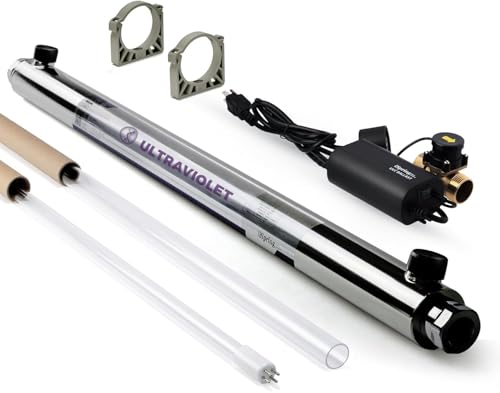
iSpring UVF55FS Whole House UV Water Filter, 12 GPM, 1 Inch Ports
$299.99 Published specsA flow sensor switch means the lamp only runs when water is actually moving, at a fraction of the price of the larger name brand systems.
Best for: A budget whole house installation on water that has already been confirmed clear
Check price on AmazonWhich UV system is the buy once pick for most well houses?
A 9 GPM stainless chamber from a manufacturer with a long parts tail is the sensible middle choice for a one or two bathroom well house.

VIQUA VH200-F10 UV Whole House Water Filter System, 9 GPM
$980.00Combines a 9 GPM ultraviolet chamber with an integrated sediment pre-filter in one compact unit.
Best for: A one or two bathroom house on a private well
Check price on AmazonWhich UV system handles a full house at high flow, and who should not buy it?
The largest whole house VIQUA reports lamp output directly rather than just lamp hours, which matters at higher flow where dose margin is thinner.

VIQUA VH410M UV Water Treatment System, 18 GPM
$1,310.00Treats up to 18 GPM with a monitored sensor that reports actual UV intensity rather than only counting hours.
Best for: A whole house on a private well where flow can reach 18 gallons per minute
Check price on AmazonWho should not buy this tier: A house that has never had the well tested, because ultraviolet treats a problem you have to confirm exists and does nothing about anything else in the water, including bacteria the lamp was never sized to handle if flow exceeds the rated dose curve. Get a certified laboratory test, including a coliform panel, before this purchase rather than after it.
Why does an ultraviolet lamp need replacing every year even if it still glows?
Lamp output falls steadily over its service life well before the lamp visibly stops working, so a lamp that still lights can already be delivering well under its rated dose with no indication at all. Manufacturers publish a fixed replacement interval, commonly around a year or 9,000 hours, and the correct practice is to replace it on that date regardless of appearance. The quartz sleeve around the lamp needs separate attention too, because mineral scale on the sleeve blocks ultraviolet light while the lamp itself keeps reading as normal, which is why a replacement sleeve with new O-rings and a genuine replacement lamp both belong on a well owner maintenance calendar rather than only being bought after a failure.
How we chose these products
We compared manufacturer published dose classes, flow ratings and water clarity prerequisites, along with verified owner reviews, rather than installing these systems on our own well. Every dose figure and flow rating above comes from the NSF/ANSI 55 standard or from the manufacturer own published specification for that specific model.
How we chose
We did not test this equipment in person and we never claim to. Picks are researched from manufacturer specification sheets, published standards and regulatory limits, and the recurring themes in verified owner reviews. Every pick is matched to a real grain capacity, a real micron rating, a real certified claim or a real flow rating rather than to a price bracket, and it is placed in the tier where its published capability actually belongs. We rejected the unbranded flood that dominates several of these search results, because a softener is a pressure vessel on the main line and a filter is the only thing between a contaminant and a glass of water, and neither is a place for a product with no parts channel and no service path. Where a figure is trade convention rather than a published standard we label it that way, and where a manufacturer does not publish a figure we leave it out instead of estimating it. Above all, we do not recommend equipment for a problem nobody has measured.
Sources
- NSF/ANSI 55 ultraviolet microbiological water treatment systems standard
- Manufacturer published specifications for the UV systems and parts linked on this page
Frequently asked questions
Can a UV purifier make my well water safe to drink on its own?
No single product on this page, or anywhere on this site, makes water safe to drink, because that is a laboratory result rather than a property of any product. Ultraviolet disinfection inactivates microorganisms present in the water at the moment of treatment, but it removes nothing and addresses nothing else the water might contain, so it is only ever part of a system built around a certified laboratory test.
How do I know if I need Class A or Class B ultraviolet treatment?
A certified laboratory test including a coliform bacteria panel is the deciding factor, not a guess. Water not known to be safe, which describes most untested or positive tested private wells, needs Class A at 40 mJ/cm2. Class B at 16 mJ/cm2 is supplemental treatment only for water already established as safe by other means, and using it on an untested or contaminated well is a genuinely dangerous substitution.
Why did my UV system stop working even though the lamp is still lit?
Ultraviolet output falls steadily over the life of the lamp long before it visibly dims, so a lit lamp can already be well under its rated dose. A scaled quartz sleeve produces the identical symptom by blocking light while the lamp itself is fine. Both failures are silent, which is why manufacturers specify a fixed annual lamp replacement and a regular sleeve cleaning schedule rather than waiting for a visible sign.
Does a UV system need a water softener installed ahead of it?
If hardness is measured above roughly 7 grains per gallon, yes, because harder water scales the quartz sleeve and blocks the light the lamp produces, silently reducing delivered dose. Iron above 0.3 mg/L and manganese above 0.05 mg/L cause the same failure by coating the sleeve. UV goes last in the treatment order specifically so the water reaching it has already been cleared of these issues.
Will a UV system work if my household flow exceeds its rated GPM?
No, at least not at its full rated dose. Delivered dose falls in direct proportion as flow rises past the system rated gallons per minute, and the failure is silent: nothing on the unit indicates the dose has dropped below the safe threshold. Sizing to your household actual peak simultaneous flow, not just the nameplate GPM, is the entire point of choosing among the tiers on this page.
Is bacteria the only thing ultraviolet treatment addresses?
Yes, in the sense that UV is a microbiological treatment, not a chemical or mineral one. It has no effect on iron, manganese, hardness, pH, nitrate, lead, arsenic or PFAS. Bacteria, nitrate, lead, arsenic and PFAS are never do it yourself topics regardless of what treatment is installed, and they each need a certified laboratory test and usually a licensed professional or your local health department.
Get the complete water treatment shopping list
Every item in the starter, complete and premium systems for both city water and well water, with running totals, in one printable list. It opens with the test kit, because that is genuinely the first purchase. No charge.
One list, no sequence of daily emails, and you can leave at any time.
Researched, not professional advice. This page is compiled from published standards, regulatory limits, manufacturer specifications and owner-review consensus, not hands-on testing. Nothing here diagnoses a water problem or says any product makes water safe to drink. Figures described as a rule of thumb are water treatment trade convention rather than published standards, and they are labeled that way wherever they appear. Test your water before you buy equipment: on city water start with the Consumer Confidence Report your utility publishes each year, and on a private well only a certified laboratory test tells you what you have. Bacteria, nitrate, lead, arsenic and PFAS are not do it yourself topics, they are invisible and tasteless, and they need a laboratory and usually a licensed professional rather than a product. Remember that a certification covers a specific claim under a specific standard, so "NSF certified" with no number attached tells you very little.