Household
What does filtered water actually cost per gallon?
Quick answer
A $200 system with $60 of cartridges a year, producing 3 gallons a day over 5 years, costs about $9.1 per hundred gallons, or $0.091 per gallon. Bottled water at a dollar a liter is roughly $3.79 per gallon, which is a difference of about two orders of magnitude.
The comparison people actually want is filtered water against bottled water, and the honest version of it counts equipment amortized over its life plus consumables, not just the sticker price.
It is worth saying plainly that the arithmetic almost always favors filtration by a wide margin, and that this is not the reason to choose a technology. What a filter addresses is decided by a laboratory result and a certified claim, not by cost per gallon.
Work out your own cost per gallon
About $0.091 per gallon, against $1.50 for bottled.
| Figure | Value |
|---|---|
| Total cost over the period | $500.0 |
| Total volume | 5,475.0 gallons |
| Cost per gallon | $0.091 |
| Cost per hundred gallons | $9.1 |
| Bottled equivalent | $8,212.5 |
| Saved over the period | $7,712.5 |
Shown with the example figures above. Change any field to run your own numbers.
The working
Rule of thumbtotal cost = equipment + (annual consumables x years) total volume = daily gallons x 365 x years cost per gallon = total cost / total volume
Straightforward arithmetic on figures you supply. Nothing here is a published standard, and the result is only as good as your own assumptions about system life. Water treatment trade convention rather than a published standard. Taught everywhere, useful for planning, and not a specification. No standards body publishes it.
Systems at different running costs
A cheap system with expensive proprietary cartridges can cost more over five years than a dearer one taking standard sizes, which is worth checking before buying.

APEC Water RO-90 5 Stage Under Sink Reverse Osmosis System, 90 GPD
$219.99A 90 GPD membrane, which fills the tank faster and matters more than it sounds on cold or low pressure supplies.
Best for: A household that empties the tank faster than a 50 GPD membrane refills it
Check price on Amazon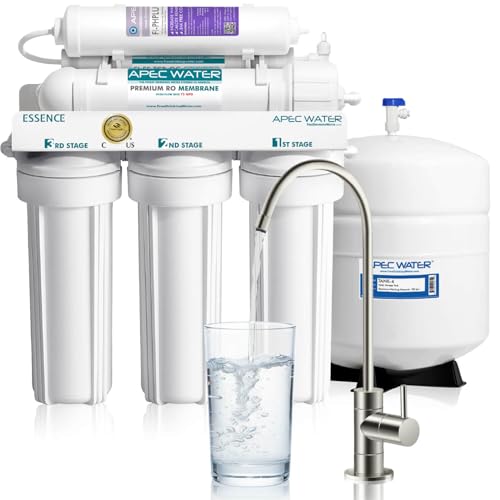
APEC Water ROES-PH75 6 Stage Under Sink RO System with Alkaline Stage, 75 GPD
$189.99 Published specsAdds a remineralisation stage after the membrane, which puts back some of the minerals reverse osmosis strips and changes the flat taste people complain about.
Best for: Anyone who tried reverse osmosis water and found it tasted flat
Check price on Amazon
APEC Water ROES-50 5 Stage Under Sink Reverse Osmosis System, 50 GPD
$179.99The most widely installed entry reverse osmosis system here, with standard sized cartridges that are available from many suppliers rather than one.
Best for: A first reverse osmosis system under a kitchen sink
Check price on Amazon
CuZn UC-200 Under Sink Water Filter
$121.43A KDF and carbon bed with a published five year filter life, certified to NSF/ANSI 42 and 372.
Check before buying: NSF/ANSI 372 covers the lead content of the materials, not lead removal. The 42 certification covers aesthetic effects.
Best for: The longest service interval available at the point of use
Check price on Amazon
Waterdrop 15UA Under Sink Water Filter System, 19,000 Gallons
$51.29A longer life cartridge at 19,000 gallons, which for most households is roughly two years between changes.
Best for: A household that would rather change a cartridge every other year
Check price on Amazon
Waterdrop 10UA Under Sink Water Filter System
$37.99Certified to NSF/ANSI 42 for aesthetic effects, with a direct connect fitting that installs without cutting into the supply line.
Check before buying: NSF/ANSI 42 is aesthetic effects: taste, odor and chlorine. It is not a health effects claim and it is not a lead claim.
Best for: A fast improvement in drinking water taste with no plumbing work
Check price on AmazonEvery figure shown is the manufacturer own published specification. None of this is a recommendation for water you have not tested: the arithmetic above is only as good as the numbers you put into it, and on a private well those numbers come from a certified laboratory rather than from a chart.
What bottled water costs for comparison
Even at bulk supermarket prices, bottled water runs one to four dollars a gallon, against cents for filtered.
Rule of thumb Water treatment trade convention rather than a published standard. Taught everywhere, useful for planning, and not a specification. No standards body publishes it.
| Format | Rough cost per gallon |
|---|---|
| Single use half liter bottles | about $5 to $8 |
| Liter bottles | about $3 to $4 |
| Supermarket gallon jugs | about $1 to $2 |
| Refill station | about $0.35 to $0.50 |
| Filtered at home | usually well under $0.10 |
These are typical retail ranges rather than published figures, and they vary widely by region and format. The point is the order of magnitude rather than the precise number.
What the arithmetic leaves out
Three things, and they are worth stating rather than hiding in a footnote.
Drain water. A conventional reverse osmosis system sends roughly four gallons to drain per gallon produced, so the metered water cost is about five times the product volume. At typical municipal rates that is still small, but it is not zero, and on a well with a weak recovery it is a real constraint.
Installation. Equipment cost is not installed cost. Labor, a drain connection, a faucet hole and any permit are extra, and that is a separate question covered on HouseProjectCalc rather than here.
Cartridges nobody changes. The arithmetic assumes the consumables are actually replaced on schedule. A carbon cartridge left in for three years costs nothing extra and also does nothing, which is the worst value of all.
Frequently asked questions
Is filtered water cheaper than bottled?
By roughly two orders of magnitude. A typical under sink system with annual cartridges works out to a few cents a gallon over its life, against a dollar or more for supermarket jugs and several dollars for single use bottles. The saving is large enough that the precise assumptions barely change the conclusion.
Does reverse osmosis drain water make it more expensive?
It roughly multiplies the metered water volume by five on a conventional tank system, since about four gallons go to drain per gallon produced. At typical municipal rates that is still a small number relative to the cartridges. A permeate pump or a tankless system roughly halves it if the waste bothers you.
How long should I amortize the equipment over?
Five years is a reasonable default for a point of use system, and many last longer. Tank based whole house systems rated at a million gallons often run ten years or more. The shorter the period you assume, the worse filtration looks, so it is worth being honest about how long you expect to stay in the house.
Are the cartridge costs the main expense?
Over the life of a system, usually yes. Equipment is a one off and cartridges repeat, so a cheap system with expensive proprietary cartridges can easily cost more over five years than a dearer one taking standard sizes. That is a good reason to prefer systems using widely available standard cartridges.
Does this tell me which filter to buy?
No. Cost per gallon compares running costs between options that both address your problem. Which technology you need is decided by a certified laboratory result matched to a specific certified claim under the relevant NSF/ANSI standard. A cheap filter that does not address your actual contaminant is not good value at any price.
Get the complete water treatment shopping list
Every item in the starter, complete and premium systems for both city water and well water, with running totals, in one printable list. It opens with the test kit, because that is genuinely the first purchase. No charge.
One list, no sequence of daily emails, and you can leave at any time.
Researched, not professional advice. This page is compiled from published standards, regulatory limits, manufacturer specifications and owner-review consensus, not hands-on testing. Nothing here diagnoses a water problem or says any product makes water safe to drink. Figures described as a rule of thumb are water treatment trade convention rather than published standards, and they are labeled that way wherever they appear. Test your water before you buy equipment: on city water start with the Consumer Confidence Report your utility publishes each year, and on a private well only a certified laboratory test tells you what you have. Bacteria, nitrate, lead, arsenic and PFAS are not do it yourself topics, they are invisible and tasteless, and they need a laboratory and usually a licensed professional rather than a product. Remember that a certification covers a specific claim under a specific standard, so "NSF certified" with no number attached tells you very little.