Filter life
How long does a 10,000 gallon cartridge last at 200 gallons a day?
Quick answer
A 10,000 gallon rated cartridge used at 200 gallons a day, which is roughly a 3 person household, lasts about 50 days or 1.6 months. Treat that as a ceiling rather than a schedule: the real change trigger is a 10 to 15 psi rise in pressure drop across the housing.
Cartridge life looks like simple division, and the division is right, but the rated gallons figure underneath it is measured against a defined laboratory test challenge rather than against your water. On genuinely dirty water a cartridge can plug in a fraction of its rating, and on clean city water it can outlast it while quietly losing the chlorine capacity it was bought for.
So the calculation below tells you when to start expecting a change, and the pressure gauges tell you when to actually make one.
On this page
The arithmetic
The working
Published figurecartridge life in days = rated gallons / gallons used per day = 10,000 / 200 = 50 days = 1.6 months
The rated gallons figure is a manufacturer specification measured against a defined test challenge. It is a published figure, but it is published for test water rather than for yours.
What 10,000 gallons means at different household sizes
The same 10,000 gallon cartridge lasts 3.3 months at 100 gallons a day and only 0.8 months at 400.
Rule of thumb Water treatment trade convention rather than a published standard. Taught everywhere, useful for planning, and not a specification. No standards body publishes it.
| Daily use | Roughly | Life in days | Life in months |
|---|---|---|---|
| 100 gallons per day | about 1 people | 100 days | 3.3 months |
| 150 gallons per day | about 2 people | 67 days | 2.2 months |
| 200 gallons per day | about 3 people | 50 days | 1.6 months |
| 250 gallons per day | about 3 people | 40 days | 1.3 months |
| 300 gallons per day | about 4 people | 33 days | 1.1 months |
| 400 gallons per day | about 5 people | 25 days | 0.8 months |
Household size is estimated at the 80 gallons per person per day the trade sizes on, which is deliberately conservative. Measured indoor use in published end use studies runs closer to 59 gallons per person.
Why pressure drop beats both the calendar and the gallons
A sediment cartridge fails by loading up, and loading up shows as resistance. That is directly measurable and it costs about twenty dollars to measure: a pressure gauge either side of the housing, read with a fixture running.
A clean cartridge should drop only a pound or two. The industry change out point is a rise of 10 to 15 pounds per square inch above that clean baseline. Waiting past it does not improve filtration, it just throttles the house and eventually collapses or bypasses the cartridge.
A carbon cartridge is the opposite problem and the reason the calendar still matters. Carbon exhausts chemically rather than mechanically, so it stops reducing chlorine long before it restricts any flow. There is no pressure symptom at all, which is exactly why a carbon stage gets changed on its rated gallons or on a date.
What shortens a cartridge faster than the arithmetic suggests
Sediment load. A well carrying sand or silt can plug a fine cartridge in days. That is what a spin down prefilter and coarse to fine staging exist to prevent, and it is the single biggest difference between a cartridge that meets its rating and one that does not.
Starting too fine. Going straight to a 1 micron cartridge on visibly dirty water is the commonest cause of a filter that seems to die immediately. Stage it: coarse first, fine second.
Iron. Oxidized iron blinds a cartridge quickly and is a job for an iron filter rather than for consumables.
Biofilm in a clear housing. A clear bowl in daylight grows algae, which shortens life and is unpleasant. Keep clear housings out of direct light.
Cartridges and the gauges that tell you when to change them
Chosen against the numbers on this page rather than from a general list, so the recommendation cannot contradict the arithmetic above. Every figure quoted is the manufacturer own published specification, and none of it is a recommendation for water you have not tested.

Pentair Pentek DGD-5005-20 Big Blue Dual Gradient Sediment Filter, 20 Inch
$36.12 Published specsTwo densities in one cartridge, 50 micron on the outside stepping to 5 micron inside, which is staged filtration without a second housing.
Best for: Well water with mixed particle sizes, where a single 5 micron cartridge would plug in weeks
Check price on Amazon
Pentair Pentek DGD-2501-20 Big Blue Dual Gradient Sediment Filter, 20 Inch
$42.48 Published specsThe finer dual gradient, stepping 25 micron to 1 micron, for water that has already had the coarse material taken out.
Best for: A second stage after a coarse prefilter or a spin down
Check price on Amazon
Pentair Pentek ECP20-20BB Big Blue Pleated Sediment Filter, 20 Inch, 20 Micron
$46.55 Published specsPleated media gives far more surface area than a spun cartridge, so it holds more dirt before the pressure drop climbs.
Best for: A high sediment load where cartridge life is the complaint
Check price on Amazon
Pentair Pentek R50-BB Big Blue Pleated Sediment Filter, 10 by 4.5 Inch, 2 Pack
$32.44 Published specsA washable pleated cartridge in the short big blue size, which can be rinsed and reused several times before replacement.
Best for: A coarse first stage on visibly dirty well water
Check price on Amazon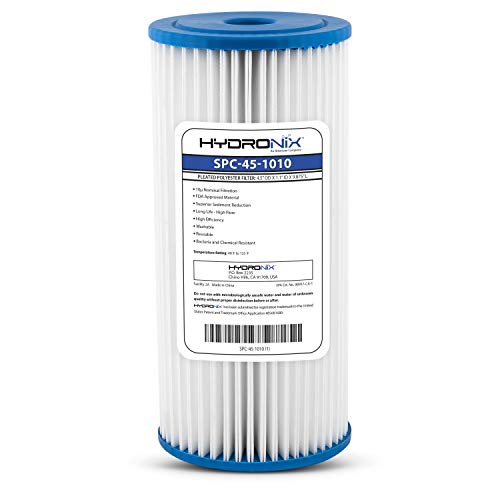
Hydronix SPC-45-1010 Washable Pleated Sediment Filter, 10 by 4.5 Inch
$12.64 Published specsThe cheapest credible washable pleated cartridge here, which turns a consumable into something closer to a maintenance task.
Best for: A coarse prefilter position that would otherwise eat cartridges
Check price on Amazon
PUREPLUS 5 Micron Whole House Pleated Sediment Filter, 10 by 4.5 Inch, 2 Pack
$29.99 Published specsPleated surface area at a low price per cartridge, in the short big blue size.
Best for: Routine replacement where the housing is already in place
Check price on AmazonHow we chose
We did not test this equipment in person and we never claim to. Picks are researched from manufacturer specification sheets, published standards and regulatory limits, and the recurring themes in verified owner reviews. Every pick is matched to a real grain capacity, a real micron rating, a real certified claim or a real flow rating rather than to a price bracket, and it is placed in the tier where its published capability actually belongs. We rejected the unbranded flood that dominates several of these search results, because a softener is a pressure vessel on the main line and a filter is the only thing between a contaminant and a glass of water, and neither is a place for a product with no parts channel and no service path. Where a figure is trade convention rather than a published standard we label it that way, and where a manufacturer does not publish a figure we leave it out instead of estimating it. Above all, we do not recommend equipment for a problem nobody has measured.
Frequently asked questions
How often should I change a 10,000 gallon cartridge?
At 200 gallons a day the arithmetic gives about 1.6 months. Treat that as when to start checking rather than as a schedule. The reliable trigger is a 10 to 15 psi rise in pressure drop across the housing above its clean baseline, which needs two cheap gauges and tells you the truth about your own water.
Why did my cartridge plug so much faster than rated?
Because the rating is measured against a defined laboratory test challenge, not against your water. A well carrying silt or oxidized iron can plug a fine cartridge in days. The fix is staging: a coarse spin down or 50 micron cartridge first so the fine cartridge only sees what got past it, rather than asking one cartridge to do the whole job.
Can I wash and reuse a cartridge?
Only pleated cartridges sold as washable, and only a few times before the pleats hold dirt permanently. Spun, melt blown and string wound cartridges load through their depth and cannot be cleaned out, and a carbon cartridge is exhausted chemically, so washing it accomplishes nothing at all. A reusable spin down screen is the genuinely washable part of a system.
Does a carbon cartridge give any warning?
No, and that is the important difference. Carbon exhausts chemically rather than mechanically, so it stops reducing chlorine long before it restricts flow. There is no pressure symptom and frequently no taste change until well past the point of usefulness. That is why carbon stages are changed on rated gallons or on a date rather than on a gauge.
Is a higher rated cartridge always better value?
Not automatically. A higher gallons rating usually means more media, which costs more and sometimes means a coarser rating or a larger housing. The cost that matters is dollars per month of service at your own use, and on dirty water the deciding factor is usually staging rather than the rating, because a coarse prefilter extends everything behind it.
Get the complete water treatment shopping list
Every item in the starter, complete and premium systems for both city water and well water, with running totals, in one printable list. It opens with the test kit, because that is genuinely the first purchase. No charge.
One list, no sequence of daily emails, and you can leave at any time.
Researched, not professional advice. This page is compiled from published standards, regulatory limits, manufacturer specifications and owner-review consensus, not hands-on testing. Nothing here diagnoses a water problem or says any product makes water safe to drink. Figures described as a rule of thumb are water treatment trade convention rather than published standards, and they are labeled that way wherever they appear. Test your water before you buy equipment: on city water start with the Consumer Confidence Report your utility publishes each year, and on a private well only a certified laboratory test tells you what you have. Bacteria, nitrate, lead, arsenic and PFAS are not do it yourself topics, they are invisible and tasteless, and they need a laboratory and usually a licensed professional rather than a product. Remember that a certification covers a specific claim under a specific standard, so "NSF certified" with no number attached tells you very little.