Micron selection
Is a 10 micron filter right for well water, fine silt or turbidity?
Quick answer
For well water, fine silt or turbidity, sensible staging is 50 micron, then 20 micron, then 5 micron, then 1 micron. A 10 micron cartridge is coarser than the finest stage this water wants, so it works as a prefilter rather than as the final stage.
Micron ratings are the most misread specification in filtration, for two reasons. The first is that finer sounds better, and on sediment it usually is not: a cartridge that is too fine for the water plugs in days and throttles the house. The second is that the rating itself means two different things depending on one word that is often missing from the listing.
Sediment filtration is staged coarse to fine for the same reason you do not sand bare timber with the finest grit first.
On this page
Nominal and absolute are not the same claim
An absolute rating is defined: the cartridge removes at least 99.9 percent of particles at or above the stated size. A nominal rating is not standardized at all. It generally implies something like 85 percent removal, but the threshold is chosen by the manufacturer, which is why two cartridges both marked "5 micron nominal" can perform very differently.
Where this matters most is cyst reduction. An NSF/ANSI 53 cyst claim requires 1 micron absolute. A 1 micron nominal cartridge does not carry that claim and must not be treated as though it does. If a listing says a micron number without the word absolute, assume nominal.
What size things actually are
A grain of fine sand is around 50 to 100 micron and a Cryptosporidium cyst is roughly 4 to 6 micron, which is why cyst claims sit at 1 micron absolute.
Published figure A published standard, regulatory limit, unit conversion or manufacturer specification. It does not change because somebody disagrees with it.
| What it is | Typical size |
|---|---|
| Beach sand | roughly 100 to 2,000 micron |
| Fine sand and grit | roughly 50 to 100 micron |
| Silt | roughly 2 to 50 micron |
| Human hair | roughly 50 to 70 micron |
| Giardia cyst | roughly 8 to 12 micron |
| Cryptosporidium cyst | roughly 4 to 6 micron |
| Bacteria | roughly 0.2 to 2 micron |
| Dissolved minerals and metals | far below any filter rating, they pass straight through |
Dissolved contaminants have no size in this sense. Nitrate, arsenic, lead and hardness are in solution and pass through every sediment rating there is, which is why a micron number never answers a dissolved contaminant question.
Staging for well water, fine silt or turbidity
For well water, fine silt or turbidity the staging is 50 micron, then 20 micron, then 5 micron, then 1 micron, coarse first.
Rule of thumb Water treatment trade convention rather than a published standard. Taught everywhere, useful for planning, and not a specification. No standards body publishes it.
| Water source | Staging | |
|---|---|---|
| City water, no visible sediment | 5 micron | |
| City water, fine particulate or rust flakes | 20 micron, then 5 micron | |
| Well water, some sand or grit | 50 micron, then 20 micron, then 5 micron | |
| Well water, fine silt or turbidity | 50 micron, then 20 micron, then 5 micron, then 1 micron | This page |
Staging is trade convention rather than a published standard. The principle underneath it is not: a coarse cartridge protects a fine one, and a fine cartridge asked to do the whole job loads at the surface and blinds off.
Where a 10 micron cartridge fits here
A 10 micron cartridge is coarser than the finest stage this water wants, so its place here is as a prefilter rather than as the last word. That is a useful job: the coarse cartridge is what makes the fine one last.
On its own at 10 micron you will still see fine particulate get through, which matters if there is a ultraviolet system downstream, because turbidity shades organisms from the lamp.
The pressure gauge is the whole diagnostic
Whatever rating you choose, put a pressure gauge either side of the housing. A clean cartridge should drop only a pound or two. A rise of 10 to 15 pounds per square inch above that clean baseline is the industry change out point.
That one measurement tells you three separate things: when to change the cartridge, whether the rating is too fine for the water, and whether the housing is undersized for the flow. If a brand new cartridge already drops more than a couple of pounds, the answer is a bigger housing or a coarser rating rather than a different brand.
Cartridges around 10 micron
Chosen against the numbers on this page rather than from a general list, so the recommendation cannot contradict the arithmetic above. Every figure quoted is the manufacturer own published specification, and none of it is a recommendation for water you have not tested.

Pentair Pentek ECP20-20BB Big Blue Pleated Sediment Filter, 20 Inch, 20 Micron
$46.55 Published specsPleated media gives far more surface area than a spun cartridge, so it holds more dirt before the pressure drop climbs.
Best for: A high sediment load where cartridge life is the complaint
Check price on Amazon
PUREPLUS 5 Micron Whole House Pleated Sediment Filter, 10 by 4.5 Inch, 2 Pack
$29.99 Published specsPleated surface area at a low price per cartridge, in the short big blue size.
Best for: Routine replacement where the housing is already in place
Check price on Amazon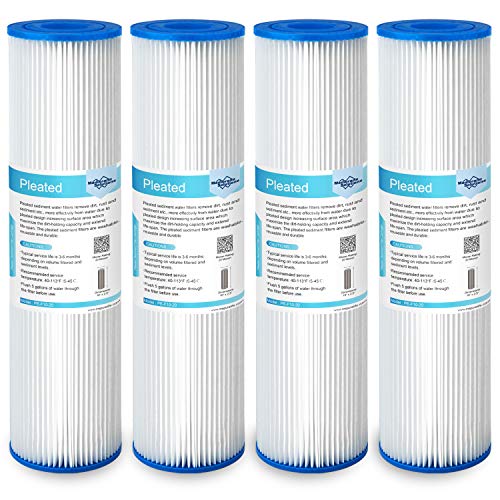
Membrane Solutions 20 Micron Pleated Sediment Water Filter, 10 by 2.5 Inch
$28.98 Published specsA 20 micron coarse pleated cartridge for the standard housing size, which is the right first stage on silty water.
Best for: The coarse stage of a two cartridge sediment train
Check price on Amazon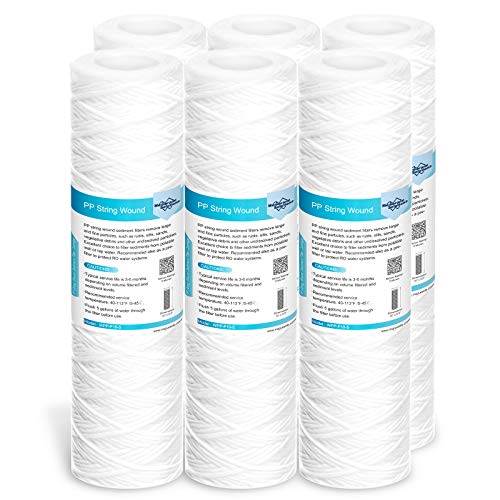
Membrane Solutions 5 Micron String Wound Water Filter, 10 by 2.5 Inch
$32.98 Published specsDepth loading at 5 micron, which lasts longer than a spun cartridge of the same rating on water carrying fine particulate.
Best for: A fine stage on well water with steady fine sediment
Check price on Amazon
Aquaboon 5 Micron String Wound Sediment Water Filter, 6 Pack
$31.79 Published specsSix cartridges at a low unit cost, which matters because a sediment cartridge on well water is a genuine consumable.
Best for: A year of changes bought at once
Check price on Amazon
iSpring WSP-50 Spin Down Sediment Filter, 50 Micron
$59.99A flushable 50 micron stainless screen with a clear bowl, so sand is visible and can be blown down without opening anything.
Best for: The very first stage on any well with grit
Check price on AmazonHow we chose
We did not test this equipment in person and we never claim to. Picks are researched from manufacturer specification sheets, published standards and regulatory limits, and the recurring themes in verified owner reviews. Every pick is matched to a real grain capacity, a real micron rating, a real certified claim or a real flow rating rather than to a price bracket, and it is placed in the tier where its published capability actually belongs. We rejected the unbranded flood that dominates several of these search results, because a softener is a pressure vessel on the main line and a filter is the only thing between a contaminant and a glass of water, and neither is a place for a product with no parts channel and no service path. Where a figure is trade convention rather than a published standard we label it that way, and where a manufacturer does not publish a figure we leave it out instead of estimating it. Above all, we do not recommend equipment for a problem nobody has measured.
Frequently asked questions
What micron filter do I need for well water, fine silt or turbidity?
Stage it 50 micron, then 20 micron, then 5 micron, then 1 micron, coarse first. A single cartridge asked to do the whole job loads at the surface and blinds off, which is why one fine cartridge on dirty water plugs in days while the same cartridge behind a coarse prefilter lasts its rated life.
Is a lower micron rating always better?
No, and on sediment it is usually worse. A cartridge finer than the water needs plugs quickly, cuts flow and throttles the house, without catching anything useful that a coarser one missed. Dissolved contaminants are unaffected by any rating. Finer is only better when there is a specific certified claim, such as 1 micron absolute for cysts.
What is the difference between nominal and absolute?
Absolute is defined as at least 99.9 percent removal at the stated size. Nominal is not standardized at all: it generally implies around 85 percent, but the manufacturer chooses the threshold. Two cartridges marked the same nominal rating can perform very differently. An NSF/ANSI 53 cyst claim requires 1 micron absolute specifically.
Will a sediment filter remove bacteria?
Not reliably, and it must not be relied on. Bacteria run roughly 0.2 to 2 micron, below most sediment ratings, and a cartridge that traps organisms becomes somewhere for them to grow. Microbiological treatment is ultraviolet at an adequate dose or a specific certified claim. A positive bacteria test is a public health matter and needs a laboratory and usually a professional.
How do I know when to change it?
Pressure drop, not the calendar. Fit a gauge either side of the housing, note the drop with a fresh cartridge, and change when it rises 10 to 15 pounds per square inch above that baseline. Rated gallons are measured against a laboratory test challenge rather than your water, so they are an upper bound rather than a schedule.
Get the complete water treatment shopping list
Every item in the starter, complete and premium systems for both city water and well water, with running totals, in one printable list. It opens with the test kit, because that is genuinely the first purchase. No charge.
One list, no sequence of daily emails, and you can leave at any time.
Researched, not professional advice. This page is compiled from published standards, regulatory limits, manufacturer specifications and owner-review consensus, not hands-on testing. Nothing here diagnoses a water problem or says any product makes water safe to drink. Figures described as a rule of thumb are water treatment trade convention rather than published standards, and they are labeled that way wherever they appear. Test your water before you buy equipment: on city water start with the Consumer Confidence Report your utility publishes each year, and on a private well only a certified laboratory test tells you what you have. Bacteria, nitrate, lead, arsenic and PFAS are not do it yourself topics, they are invisible and tasteless, and they need a laboratory and usually a licensed professional rather than a product. Remember that a certification covers a specific claim under a specific standard, so "NSF certified" with no number attached tells you very little.