Regeneration
How often does a 64,000 grain softener regenerate at 40 grains per gallon?
Quick answer
A 64,000 grain softener on 40 grain water, serving a four person household, regenerates roughly every 2.5 days at an efficient 8 pound salt setting, using about 16.0 pounds of salt per cycle. That interval is undersized against the three to fourteen day target.
Regeneration frequency is not a setting somebody picks, it is what falls out of three numbers: how much capacity the resin bed genuinely has at the salt dose it is programmed to, how many grains the household removes in a day, and how much capacity is held back in reserve.
The interval matters in both directions. Regenerating more often than every 3 days burns salt and water and shortens resin life. Leaving a bed loaded for longer than about 14 days lets it channel, and on well water it gives bacteria somewhere undisturbed to live, which is why most manufacturers force a cycle on a calendar regardless of metered demand.
What the salt setting actually changes
Dropping from a 15 pound salt dose to 6 pounds costs about 33 percent of the capacity and buys roughly 67 percent more grains removed per pound of salt.
Published figure A published standard, regulatory limit, unit conversion or manufacturer specification. It does not change because somebody disagrees with it.
| Salt dose | Capacity per cycle | Salt efficiency | Days between cycles | Salt per year |
|---|---|---|---|---|
| 6 lb per cu ft | 40,000 grains | 3,333 grains per lb | 2.1 days | 2,086 lb |
| 8 lb per cu ft | 44,800 grains | 2,800 grains per lb | 2.5 days | 2,336 lb |
| 10 lb per cu ft | 48,000 grains | 2,400 grains per lb | 2.8 days | 2,607 lb |
| 12 lb per cu ft | 54,000 grains | 2,250 grains per lb | 3.2 days | 2,738 lb |
| 15 lb per cu ft | 60,000 grains | 2,000 grains per lb | 3.7 days | 2,959 lb |
Resin exchange capacity against salt dose is a published figure from resin manufacturers. NSF/ANSI 44 sets 3,350 grains per pound as the high efficiency threshold, and a unit only meets it at the setting the certification was earned at.
Is 64,000 grains the right size for this water?
No. This combination is undersized. At 40 grains per gallon a four person household removes 12,800 grains a day, and a 64,000 grain unit at an efficient salt setting holds 44,800 grains before the reserve is deducted. It would be regenerating constantly, which wastes salt and water and wears the resin out early.
The answer is a larger nameplate rather than a heavier salt dose. Pushing a small unit to a 15 pound dose buys capacity at the worst possible efficiency, and the salt bill over a few years exceeds the price difference between the two machines.
What happens during a regeneration
- Backwash. Flow is reversed up through the resin bed to lift and rinse out the sediment and iron that has collected on top of it, and to re-settle the bed evenly.
- Brine draw and slow rinse. Concentrated brine is drawn from the salt tank and pulled slowly through the resin. The sodium displaces the calcium and magnesium the resin has collected, which is the actual regeneration.
- Fast rinse. Clean water at full flow flushes the remaining brine out of the bed and re-packs it, so the first water back into the house is not salty.
- Brine refill. Water is metered back into the salt tank to dissolve the salt for the next cycle. This is why the tank holds a few inches of water between regenerations, which surprises people who open the lid.
Softeners at this capacity, and the salt they run on
Chosen against the numbers on this page rather than from a general list, so the recommendation cannot contradict the arithmetic above. Every figure quoted is the manufacturer own published specification, and none of it is a recommendation for water you have not tested.

AFWFilters Premium Fleck 64,000 Grain Water Softener with 10 Percent Resin
$879.00 Published specsTwo cubic feet of ten percent crosslinked resin on a Fleck valve, at a lower price than most equivalent builds.
Best for: A large household on hard chlorinated water
Check price on Amazon
Aquasure Harmony Series 70,000 Grain Water Softener
$899.99A large nameplate for very hard water or a large household, where a smaller unit would regenerate every two or three days and burn salt doing it.
Best for: Five or more people, or hardness above about 25 grains per gallon
Check price on Amazon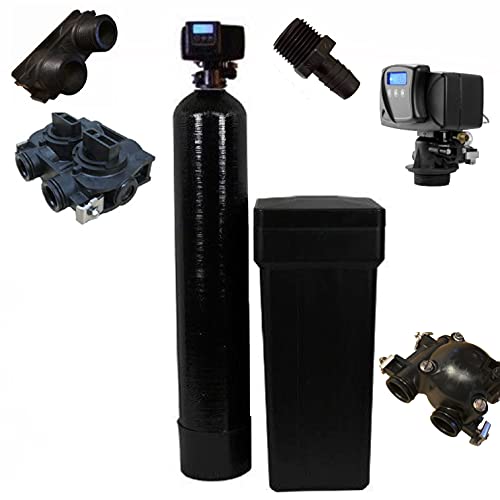
DuraWater Fleck 5600SXT 64,000 Grain Water Softener with 10 Percent Resin
$905.00 Published specsTwo cubic feet of ten percent crosslinked resin, which resists chlorine damage better than the standard eight percent and matters on chlorinated city water.
Best for: A large household, or city water with an aggressive chlorine residual
Check price on Amazon
Morton Clean and Protect Water Softener Salt Pellets, 40 lb, 2 Pack
$35.00 Published specsMorton own listing rather than a repackager, at roughly half what the multipack resellers charge for the same pellets.
Check before buying: Softener salt is usually far cheaper per bag at a hardware store or grocery, because shipping forty pound bags dominates the online price.
Best for: Topping up a brine tank between grocery runs
Check price on Amazon
Diamond Crystal Bright and Soft Water Softener Salt Pellets, 50 lb
$34.95High purity evaporated salt pellets, which leave less insoluble residue in the brine tank than rock salt and so need the tank cleaned out less often.
Best for: Anyone tired of shovelling mush out of the bottom of a brine tank
Check price on Amazon
Morton Water Softener Cleanser
$20.38A resin bed cleaner for iron, sediment and rust, which is the maintenance step that extends resin life on well water and almost nobody does.
Best for: A softener on water carrying any measurable dissolved iron
Check price on AmazonHow we chose
We did not test this equipment in person and we never claim to. Picks are researched from manufacturer specification sheets, published standards and regulatory limits, and the recurring themes in verified owner reviews. Every pick is matched to a real grain capacity, a real micron rating, a real certified claim or a real flow rating rather than to a price bracket, and it is placed in the tier where its published capability actually belongs. We rejected the unbranded flood that dominates several of these search results, because a softener is a pressure vessel on the main line and a filter is the only thing between a contaminant and a glass of water, and neither is a place for a product with no parts channel and no service path. Where a figure is trade convention rather than a published standard we label it that way, and where a manufacturer does not publish a figure we leave it out instead of estimating it. Above all, we do not recommend equipment for a problem nobody has measured.
Frequently asked questions
How often should a 64,000 grain water softener regenerate?
On 40 grain water with four people in the house, about every 2.5 days at an efficient salt setting. The target window is 3 to 14 days: more often than that wastes salt and water, and less often lets the resin bed channel, which is why control valves force a cycle on a calendar.
How long does a regeneration take?
Most residential cycles run between about an hour and two hours end to end, across backwash, brine draw, slow rinse, fast rinse and brine refill. The exact timing is programmed into the control valve and is on its specification sheet. Softeners are normally set to regenerate in the early hours precisely because the house gets untreated water while it happens.
Why does my softener regenerate when nobody used water?
Most likely a forced calendar cycle. Manufacturers program a regeneration at least every seven to fourteen days regardless of metered demand, because a resin bed that sits fully loaded starts to channel and, on well water, gives bacteria somewhere undisturbed to live. If it is happening nightly instead, that points at a stuck meter, a wrong hardness setting or a valve fault.
How much salt does one regeneration use?
About 16.0 pounds at an efficient 8 pound per cubic foot setting, or 30.0 pounds at a maximum 15 pound dose. The heavier dose buys more capacity per cycle but at much worse efficiency, roughly 2,000 grains per pound against 3,333 at the lightest setting.
Can I just turn the salt setting down to save money?
Within the range the manufacturer supports, yes, and it genuinely improves salt efficiency. What it also does is cut the capacity per cycle, so the unit regenerates more often. If it drops below about 3 days between cycles you have traded a salt saving for more water down the drain and faster resin wear, which is not a saving at all.
Get the complete water treatment shopping list
Every item in the starter, complete and premium systems for both city water and well water, with running totals, in one printable list. It opens with the test kit, because that is genuinely the first purchase. No charge.
One list, no sequence of daily emails, and you can leave at any time.
Researched, not professional advice. This page is compiled from published standards, regulatory limits, manufacturer specifications and owner-review consensus, not hands-on testing. Nothing here diagnoses a water problem or says any product makes water safe to drink. Figures described as a rule of thumb are water treatment trade convention rather than published standards, and they are labeled that way wherever they appear. Test your water before you buy equipment: on city water start with the Consumer Confidence Report your utility publishes each year, and on a private well only a certified laboratory test tells you what you have. Bacteria, nitrate, lead, arsenic and PFAS are not do it yourself topics, they are invisible and tasteless, and they need a laboratory and usually a licensed professional rather than a product. Remember that a certification covers a specific claim under a specific standard, so "NSF certified" with no number attached tells you very little.