Well water filtration
Which whole house water filter should you buy for well water?
Quick answer
Whole house filtration for well water is chosen after a certified laboratory test, sediment staged coarse to fine, and dissolved iron confirmed at a level a cartridge can actually handle, commonly cited up to around 3 ppm: above that, a cartridge filter plugs fast and a dedicated backwashing iron filter is the correct machine instead.
Well water is a different sizing problem from city water for one reason: nobody tests it but the owner. There is no annual Consumer Confidence Report and no operator watching a treatment plant, so the entire argument of this page is that a certified laboratory test comes before any equipment purchase, not after a taste complaint. Iron, manganese, sulfur odor, low pH and, on some wells, bacteria all look similar from a symptom description and need entirely different treatment.
A cartridge based whole house filter can handle sediment and a modest amount of dissolved iron or manganese, but it is not the same category of equipment as a backwashing oxidizing filter, and using the wrong one is the most expensive mistake in this niche. The systems below are grouped by how much of that job a cartridge can genuinely do before a dedicated iron filter becomes the honest answer.
On this page
- Why nobody tests well water but the owner
- Clear water iron, red water iron and iron bacteria are three different jobs
- Where a cartridge filter stops being enough
- How we chose
- Beginner: a compact two stage cartridge system
- Intermediate: staged sediment plus a well oriented cartridge
- Expert: genuine three housing staging
Why nobody tests well water but the owner
A city utility is required to test and publish results every year. A private well has no equivalent, no scheduled inspection and no report arriving in the mail, which means the owner is the only party who will ever know what is actually in the water unless they order the test themselves. A certified laboratory test, not a filter purchase, is the correct first step, and for bacteria, nitrate, arsenic or lead specifically, that test and usually a licensed professional or the local health department are not optional: those five are invisible, tasteless and give no feedback at all when equipment stops working.
The EPA secondary standard for iron is 0.3 mg/L and for manganese is 0.05 mg/L, both aesthetic guidelines rather than enforceable health limits.
Published figure A published standard, regulatory limit, unit conversion or manufacturer specification. It does not change because somebody disagrees with it.
| Contaminant | EPA secondary standard | What it causes |
|---|---|---|
| Iron | 0.3 mg/L | Rust staining, metallic taste |
| Manganese | 0.05 mg/L | Black staining, bitter taste |
Secondary standards are guidelines rather than enforceable limits. Neither figure describes a health risk on its own.
Clear water iron, red water iron and iron bacteria are three different jobs
Dissolved (ferrous) iron is clear at the tap and turns orange only after sitting in a glass or a toilet tank; this is the form a cartridge filter or a softener can address up to a published limit. Already oxidized (ferric) iron arrives visibly orange or rusty and settles out as a particle, which a softener cannot exchange and simply plugs on; sediment filtration ahead of anything else is the right first move there. Iron bacteria shows up as a slimy orange or rust colored jelly in the toilet tank or pressure tank, often with an odor, and it is a living colony rather than a dissolved mineral. No filter or softener resolves iron bacteria; the answer is shock chlorination of the well and a retest, and it is well work rather than a filter purchase.
Where a cartridge filter stops being enough
The iron and manganese cartridge platform publishes its own limit of roughly 3 ppm iron and 1 ppm manganese, and above that a cartridge plugs within weeks rather than months regardless of brand. This is a genuine published ceiling, not marketing caution: a cartridge filter is a media exchange or adsorption device sized for a light load, and an oxidizing or backwashing iron filter is an entirely different machine built to precipitate iron out and flush it to drain automatically. Sizing that decision off a guess rather than a laboratory number is how people end up replacing cartridges every few weeks and blaming the brand instead of the level.
Well water carrying fine silt is commonly staged in four steps down to 1 micron, while a clean, low sediment well often needs only a single coarse stage.
Rule of thumb Water treatment trade convention rather than a published standard. Taught everywhere, useful for planning, and not a specification. No standards body publishes it.
| Water condition | Recommended staging, coarse to fine |
|---|---|
| Well water, minimal sediment | 5 micron single stage |
| Well water, some sand or grit | 50, then 20, then 5 micron |
| Well water, fine silt or turbidity | 50, then 20, then 5, then 1 micron |
This is trade convention rather than a published standard. Going straight to a fine cartridge on silty water is the commonest cause of a new filter killing water pressure within days.
How we chose
These systems were compared on published stage counts, port sizes, targeted contaminants and manufacturer stated ppm limits, checked against verified owner reviews for the well water specific complaints a spec sheet omits, mainly cartridge life on genuinely dirty water. Nothing here was installed on a well to test it, and nothing on this page tells you what is in your water: only a certified laboratory test does that.
Beginner: a compact two stage cartridge system
A modest, confirmed iron and manganese level on an otherwise clean well is a reasonable case for a compact two stage cartridge system, which costs far less than a backwashing filter and is realistic for a light load.

Waterdrop WHF21-FG 2 Stage Whole House Water Filter System
$138.99A compact two stage cartridge system with a published 96 percent iron and 98 percent manganese reduction figure at a low entry price.
Check before buying: NSF/ANSI 372 certifies the LEAD CONTENT of the wetted materials. It is not a lead removal claim and must not be read as one.
Best for: A confirmed, low level iron and manganese reading on an otherwise clean well
Check price on AmazonIntermediate: staged sediment plus a well oriented cartridge
A well carrying both grit and a mild taste or metals complaint benefits from staging: a spin down ahead of the cartridge stages, so sand never reaches the finer media, plus graded sediment inside the housing itself.

Waterdrop WHF3T-FG 3 Stage Whole House Water Filter System for Well Water
$296.99A three stage well oriented system with a spin down prefilter built in ahead of the cartridges, plus a published iron and manganese reduction figure from third party testing.
Best for: Well water carrying visible grit alongside a taste or metals complaint
Check price on Amazon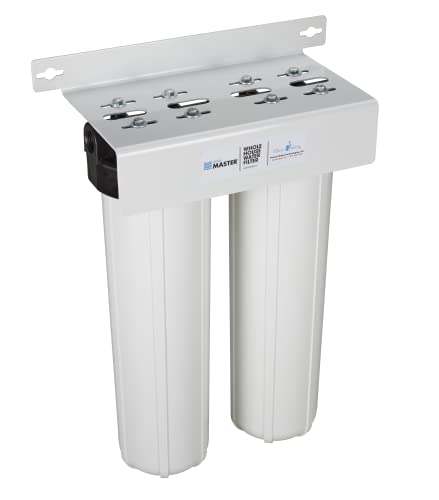
Home Master HMF2SmgCC Whole House Water Filter, 4 Layer Sediment and Carbon
$374.77 Published specsGraded density sediment from 25 down to 1 micron inside one cartridge, paired with a 95,000 gallon catalytic carbon stage.
Best for: Well water with mixed particle sizes where a single micron rating would plug fast
Check price on AmazonExpert: genuine three housing staging
Three Big Blue housings plumbed in series is the staged sediment and carbon arrangement the compact systems above are approximating. It costs more up front and takes more wall space, and it is the correct answer for a well with a heavier or more variable sediment load than a two stage cartridge system can keep up with.

Pentair Pentek BBFS-222 Big Blue Three Housing Filtration System, 1 Inch NPT
$350.75 Published specsThree 20 inch Big Blue housings pre-mounted on a bracket, rated to 40 gallons a minute, for genuine coarse to fine staging plus a carbon stage.
Best for: A well needing real multi stage sediment and carbon capacity rather than one compact cartridge doing three jobs
Check price on AmazonWho should not buy this tier: A well with a confirmed light sediment load and no metals complaint, where a two stage compact system already does the whole job for a fraction of the cost and the wall space.
A slimy orange jelly in the toilet tank, an odor that returns no matter how many cartridges are changed, or any bacteria result on a laboratory test are not filter shopping problems. Shock chlorination of the well by a licensed professional and a retest come first, and no filter or cartridge on this page substitutes for that step.
How we chose
We did not test this equipment in person and we never claim to. Picks are researched from manufacturer specification sheets, published standards and regulatory limits, and the recurring themes in verified owner reviews. Every pick is matched to a real grain capacity, a real micron rating, a real certified claim or a real flow rating rather than to a price bracket, and it is placed in the tier where its published capability actually belongs. We rejected the unbranded flood that dominates several of these search results, because a softener is a pressure vessel on the main line and a filter is the only thing between a contaminant and a glass of water, and neither is a place for a product with no parts channel and no service path. Where a figure is trade convention rather than a published standard we label it that way, and where a manufacturer does not publish a figure we leave it out instead of estimating it. Above all, we do not recommend equipment for a problem nobody has measured.
Frequently asked questions
Can a whole house filter remove iron from well water?
A cartridge filter can handle dissolved iron up to a published limit the manufacturer states for that specific model, commonly cited around 3 ppm. Above that level, or if the iron is already oxidized into visible orange particles, a cartridge plugs quickly and a dedicated backwashing oxidizing iron filter is the correct machine, sized off a certified laboratory test rather than a guess.
How do I know if my iron is dissolved or already oxidized?
Dissolved (ferrous) iron runs clear at the tap and turns orange only after sitting in a glass or the toilet tank. Already oxidized (ferric) iron is visibly orange or rusty the moment it leaves the tap and settles as particles. The two need different equipment, and a certified laboratory test alongside a simple observation at the tap is how you tell them apart before buying anything.
Does a sediment filter fix a sulfur smell in well water?
No. A sulfur or rotten egg odor is usually hydrogen sulfide gas, which a sediment cartridge does not touch at any micron rating. Catalytic carbon or an air injection oxidizing filter addresses hydrogen sulfide, and the correct choice depends on the concentration and the pH, which a certified laboratory test needs to confirm before equipment is chosen.
Do I need a water softener in addition to a well filter?
Filtration and softening are separate jobs. A whole house filter handles sediment, taste and a modest dissolved iron or manganese load, while a softener removes hardness minerals that no filter cartridge touches. Many well setups run both, in the order sediment first, then iron treatment if needed, then softener, so particulate and iron never load the resin bed.
Is iron bacteria something a filter can fix?
No. Iron bacteria is a living colony rather than a dissolved mineral, and it fouls filters and softeners rather than being removed by them. The recognized fix is shock chlorination of the well, performed by or with a licensed professional, followed by a retest. Buying a bigger filter for a slimy orange growth in the toilet tank generally makes the problem worse, not better.
How often should I test well water?
Most health departments recommend a certified laboratory test at least once a year for bacteria and nitrate, and immediately after any noticeable change in taste, odor, color or after well work or flooding nearby. There is no calendar substitute for a private well: nobody else is testing it, and equipment sized off an old test result can be treating water that no longer matches it.
Get the complete water treatment shopping list
Every item in the starter, complete and premium systems for both city water and well water, with running totals, in one printable list. It opens with the test kit, because that is genuinely the first purchase. No charge.
One list, no sequence of daily emails, and you can leave at any time.
Researched, not professional advice. This page is compiled from published standards, regulatory limits, manufacturer specifications and owner-review consensus, not hands-on testing. Nothing here diagnoses a water problem or says any product makes water safe to drink. Figures described as a rule of thumb are water treatment trade convention rather than published standards, and they are labeled that way wherever they appear. Test your water before you buy equipment: on city water start with the Consumer Confidence Report your utility publishes each year, and on a private well only a certified laboratory test tells you what you have. Bacteria, nitrate, lead, arsenic and PFAS are not do it yourself topics, they are invisible and tasteless, and they need a laboratory and usually a licensed professional rather than a product. Remember that a certification covers a specific claim under a specific standard, so "NSF certified" with no number attached tells you very little.