Well water
How to size a UV system for a well
Quick answer
Size a UV system on peak simultaneous flow from fixture count, not on household size. NSF/ANSI 55 Class A delivers 40 mJ/cm2 for water not known to be safe; Class B delivers only 16 mJ/cm2 and is supplemental for water already considered safe. Buying Class B for a coliform-positive well is dangerous.
Ultraviolet disinfection is unusually clean among water treatment technologies because its governing standard, NSF/ANSI 55, publishes an exact dose figure rather than a vague performance claim, and that number is the whole basis for sizing correctly. The trouble is that a UV system does not fail loudly. The lamp keeps glowing on schedule whether it is delivering its rated dose or a fraction of it, so an undersized or wrongly classed system gives no warning at all that it has stopped protecting the water passing through it.
This page covers sizing on peak flow, the two NSF/ANSI 55 classes and why they are not interchangeable, the water quality prerequisites UV needs to work at all, and what UV does and does not do. It assumes bacteria has already been raised by a certified laboratory test, since a positive coliform result changes the entire conversation from a sizing question to a public health one.
On this page
- Size on peak flow, not household size
- Class A and Class B are not the same product
- Dose falls in direct proportion as flow rises
- UV needs clear water to work at all
- What UV removes: nothing
- Maintenance a UV system needs regardless of sizing
- A positive coliform result changes everything
- Systems sized to a range of peak flows
Size on peak flow, not household size
A UV system's dose is a function of how long water spends inside the lamp chamber, and that dwell time is set entirely by flow rate: a chamber rated to deliver a certain dose at a stated gallons per minute delivers proportionally less dose the moment flow rises above that figure, regardless of how many people live in the house. Two households of the same size, one with a single bathroom and one with three bathrooms and a walk-in shower running simultaneously, have very different peak flow demands even though they have identical daily water use, and daily use is the wrong number to size a UV system against entirely.
Peak simultaneous demand is normally worked out from fixture count, the same convention used for whole house filter sizing, since two or three fixtures running together is a routine event in most households, not an edge case.
A house with 2 bathrooms plans for roughly 8 gallons per minute of peak simultaneous demand, the figure a UV system needs to be rated at or above.
Rule of thumb Water treatment trade convention rather than a published standard. Taught everywhere, useful for planning, and not a specification. No standards body publishes it.
| Bathrooms | Planning peak flow |
|---|---|
| 1 | 6 gpm |
| 1.5 | 7 gpm |
| 2 | 8 gpm |
| 2.5 | 9 gpm |
| 3 | 10 gpm |
| 3.5 | 12 gpm |
| 4 | 14 gpm |
This is trade convention rather than a published standard, and a house with a soaking tub, a multi head shower, or irrigation plumbed on the treated line will exceed these figures. Size the UV system to the actual peak the plumbing can draw, not the smallest unit that fits the space.
Class A and Class B are not the same product
NSF/ANSI 55 defines two classes by the dose delivered at the end of rated lamp life, and the difference between them is the difference between a system meant to disinfect an unknown water supply and one meant only to add a small margin to water already considered safe.
Class A delivers 40 mJ/cm2 for water not known to be safe; Class B delivers only 16 mJ/cm2 and is supplemental treatment only.
Published figure A published standard, regulatory limit, unit conversion or manufacturer specification. It does not change because somebody disagrees with it.
| Class | Dose | Intended use |
|---|---|---|
| Class A | 40 mJ/cm2 | Disinfection of water not known to be safe |
| Class B | 16 mJ/cm2 | Supplemental treatment of water already considered safe |
The two classes look nearly identical on a retail listing. Buying Class B for a well that has tested positive for coliform is one of the more dangerous mix-ups available in this entire category, because a Class B unit is not built or certified to disinfect water with a known problem.
Dose falls in direct proportion as flow rises
A unit rated to deliver its stated dose at a specific gallons per minute delivers less dose, in direct proportion, the moment actual flow exceeds that rating. A Class A system rated for 40 mJ/cm2 at 10 gpm delivers roughly half that dose, around 20 mJ/cm2, if the actual peak flow through it reaches 20 gpm, which is well below the 40 mJ/cm2 the classification exists to guarantee. This is exactly why sizing on genuine peak flow rather than a comfortable guess matters: a system installed for a house's typical flow but overwhelmed occasionally by peak demand fails silently at precisely the moments demand is highest.
The lamp itself gives no indication that this is happening. It lights normally regardless of whether the dose reaching the water is 40 mJ/cm2 or 15, which is the core reason UV sizing has to be done correctly the first time rather than corrected after a symptom appears, because there is no symptom.
UV needs clear water to work at all
Ultraviolet light has to physically reach the organism, so several water quality prerequisites are published by essentially every UV manufacturer, and installing a system outside these limits means it will not deliver its rated dose no matter how correctly it was sized on flow alone.
Iron below 0.3 mg/L, manganese below 0.05, hardness below 7 gpg and turbidity below 1 NTU are the published prerequisites for a UV system to deliver its rated dose.
Published figure A published standard, regulatory limit, unit conversion or manufacturer specification. It does not change because somebody disagrees with it.
| Parameter | Limit |
|---|---|
| Iron | Below 0.3 mg/L |
| Manganese | Below 0.05 mg/L |
| Hardness | Below 7 gpg, or the sleeve scales |
| Turbidity | Below 1 NTU |
| Ultraviolet transmittance | 75% or higher |
A quartz sleeve that has scaled from hardness or clouded from iron blocks UV light while the lamp still lights and reads as functioning normally. UV goes last in the treatment train precisely so it sees water that has already had iron, manganese and hardness addressed upstream.
What UV removes: nothing
Ultraviolet light inactivates organisms so they cannot reproduce; it does not filter, remove or leave behind any residual disinfectant in the water. Everything that was present before the lamp is still physically present after it, in the sense that UV changes nothing about the water's chemistry or particulate content. This makes it fundamentally different from a filter or a softener, and it is never a substitute for finding out why a well tested positive for coliform in the first place. A UV system disinfects the water passing through it going forward; it does nothing about whatever is causing bacteria to enter the well, which needs its own investigation.
Maintenance a UV system needs regardless of sizing
Replace the UV lamp annually on a fixed date rather than waiting for a symptom, because output falls steadily over the lamp's life and a lamp that still glows can be delivering well under its rated dose long before it visibly dims or fails to light. Clean or replace the quartz sleeve on the same schedule or sooner, since a scaled or clouded sleeve blocks the light reaching the water even from a fresh lamp behind it.
A positive coliform result changes everything
A positive coliform test is a public health matter first and an equipment question second. Contact the local health department, get a certified laboratory retest, and investigate why bacteria is entering the well, such as a compromised well cap, a cracked casing, or surface water intrusion, rather than treating a UV system as the complete answer to a well that has tested positive. UV disinfects water going forward; it does not fix whatever is letting bacteria into the well, and installing Class B equipment on a coliform-positive well specifically, rather than Class A, is dangerous because Class B was never certified to disinfect water in that condition.
Systems sized to a range of peak flows
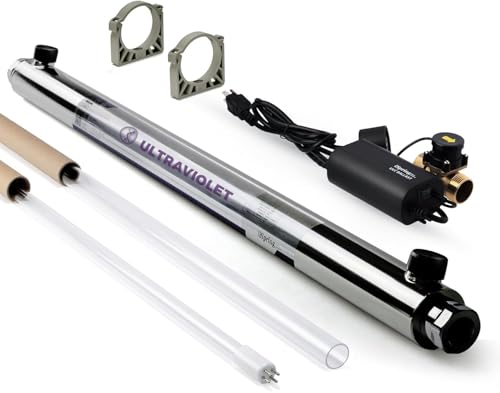
iSpring UVF55FS Whole House UV Water Filter, 12 GPM, 1 Inch Ports
$299.99 Published specsA budget whole house system with a flow sensor so the lamp only runs when water moves, rated to 12 gpm.
Best for: A budget installation where peak flow has genuinely been measured
Check price on Amazon
VIQUA VH200-F10 UV Whole House Water Filter System, 9 GPM
$980.00A 9 gpm stainless chamber suited to a one or two bathroom house rather than a larger one that would overwhelm it at peak demand.
Best for: A one or two bathroom house on a private well
Check price on Amazon
VIQUA VH410M UV Water Treatment System, 18 GPM
$1,310.00Rated to 18 gpm with monitored output rather than only lamp hours, for a larger house with a genuinely high peak flow.
Best for: A whole house install where peak flow reaches into the mid teens or higher
Check price on Amazon
HQUA TWS-12 Ultraviolet Water Purifier, 12 GPM
$259.99A widely sold 12 gpm unit with cheap and available replacement lamps and sleeves, useful where consumable cost matters over the life of the system.
Best for: A whole house installation on a tighter consumables budget
Check price on AmazonHow we chose
We did not test this equipment in person and we never claim to. Picks are researched from manufacturer specification sheets, published standards and regulatory limits, and the recurring themes in verified owner reviews. Every pick is matched to a real grain capacity, a real micron rating, a real certified claim or a real flow rating rather than to a price bracket, and it is placed in the tier where its published capability actually belongs. We rejected the unbranded flood that dominates several of these search results, because a softener is a pressure vessel on the main line and a filter is the only thing between a contaminant and a glass of water, and neither is a place for a product with no parts channel and no service path. Where a figure is trade convention rather than a published standard we label it that way, and where a manufacturer does not publish a figure we leave it out instead of estimating it. Above all, we do not recommend equipment for a problem nobody has measured.
Frequently asked questions
How do I size a UV system for my well?
Size on peak simultaneous flow, worked out from fixture count, rather than on household size or daily water use. A UV system's dose is a function of dwell time in the chamber, which depends entirely on flow rate, so a house with more bathrooms or a walk-in shower needs a higher rated system even if its total daily use is the same as a smaller house.
What is the difference between Class A and Class B UV systems?
Class A delivers 40 mJ/cm2 and is certified to disinfect water not known to be safe. Class B delivers only 16 mJ/cm2 and is supplemental treatment for water already considered safe. The two look nearly identical on a retail listing, but installing Class B on a well that has tested positive for coliform is dangerous, since it was never certified for that use.
Why does my UV lamp still light if it is not working properly?
A UV lamp's visible light output does not track its actual disinfection dose, so a lamp that lights normally can be delivering well under its rated output as it ages, or the dose reaching the water can fall because flow exceeds what the unit was sized for. Neither failure mode produces any visible symptom, which is why sizing correctly the first time and replacing lamps on schedule both matter.
Does UV remove iron or hardness from well water?
No. UV inactivates organisms and removes nothing from the water at all, including iron, manganese or hardness. Those parameters actually work against UV: iron above 0.3 mg/L, manganese above 0.05, and hardness above 7 gpg all interfere with the light reaching the organism, which is why UV is placed last in the treatment train, after those problems are addressed upstream.
My well tested positive for coliform. Does a UV system fix that?
A properly sized Class A UV system disinfects water going forward, but a positive coliform result is a public health matter that needs a certified laboratory retest and usually the local health department involved to find out why bacteria is entering the well in the first place. UV does not repair a compromised well cap, casing or other entry point.
How often does a UV lamp need to be replaced?
Annually, on a fixed date, regardless of whether the lamp still lights. Output falls steadily over the lamp's rated life, and a lamp that appears to work can be delivering a fraction of its dose long before it visibly dims. The quartz sleeve should be cleaned or replaced on the same schedule, since a scaled sleeve blocks light even from a fresh lamp.
Get the complete water treatment shopping list
Every item in the starter, complete and premium systems for both city water and well water, with running totals, in one printable list. It opens with the test kit, because that is genuinely the first purchase. No charge.
One list, no sequence of daily emails, and you can leave at any time.
Researched, not professional advice. This page is compiled from published standards, regulatory limits, manufacturer specifications and owner-review consensus, not hands-on testing. Nothing here diagnoses a water problem or says any product makes water safe to drink. Figures described as a rule of thumb are water treatment trade convention rather than published standards, and they are labeled that way wherever they appear. Test your water before you buy equipment: on city water start with the Consumer Confidence Report your utility publishes each year, and on a private well only a certified laboratory test tells you what you have. Bacteria, nitrate, lead, arsenic and PFAS are not do it yourself topics, they are invisible and tasteless, and they need a laboratory and usually a licensed professional rather than a product. Remember that a certification covers a specific claim under a specific standard, so "NSF certified" with no number attached tells you very little.