Pressure tanks and switches
Which well pressure tank and switch setup is right for your house?
Quick answer
A well pressure tank stores a pocket of pressurized air against a water filled bladder, and almost all treatment equipment installs after the tank rather than before it, because backwashing filters need steady pressure the tank supplies. The reference tank here holds a 20 gallon nominal capacity, and a common residential pressure switch cycles between 30 and 50 PSI.
A pressure tank is not a storage tank in the way people picture one. It holds a rubber diaphragm or bladder pressed against a charge of compressed air, and the tank works by letting that air charge push stored water out to the house between pump cycles rather than making the pump run continuously. Most of the usable capacity, called drawdown, is smaller than the tank nominal size because only the portion between the pump cut-in and cut-out pressure is ever delivered.
Where the tank sits relative to treatment equipment matters more than most well owners realize. Backwashing filters, softeners and neutralizers need steady pressure and flow to regenerate correctly, which a pump cycling directly on and off does not reliably provide. That is why almost all treatment equipment on this site installs after the pressure tank, not before it, and getting that order backwards is a common and avoidable mistake.
On this page
- Why does treatment equipment go after the pressure tank instead of before it?
- How much usable water does a well pressure tank actually deliver?
- What pressure switch settings does most residential well equipment use?
- Which pressure tank fits a straightforward replacement on a budget?
- Which pressure tank matches an existing pump installation?
- Which pressure tank is the long term, reference grade pick, and who should not buy it?
- How do I know if my pressure tank needs replacing rather than just recharging?
- How we chose these products
Why does treatment equipment go after the pressure tank instead of before it?
A well pump cycles on and off as pressure swings between the switch cut-in and cut-out settings, and that swing is hard on backwashing valves and softener control heads if they see it directly at the well head. The pressure tank absorbs that cycling and delivers smooth, steady pressure and flow to everything downstream, which is exactly what oxidizing filters, softeners and ultraviolet systems need to operate the way they were designed to. See filter before or after the pressure tank for the specific plumbing layout, and the full equipment order guide for how the rest of the stack lines up behind it.
How much usable water does a well pressure tank actually deliver?
A 20 gallon nominal tank delivers roughly 7.2 gallons of usable drawdown at 30/50 PSI on the one product here that publishes the figure, which is well under half the nominal size.
Published figure A published standard, regulatory limit, unit conversion or manufacturer specification. It does not change because somebody disagrees with it.
| Tank | Nominal capacity | Published drawdown at 30/50 PSI |
|---|---|---|
| Amtrol Well-X-Trol WX-202 Well Pressure Tank, 20 Gallon | 20 gallons | Not published on this listing |
| Reliance Pre-Charged Well Pressure Tank, 20 Gallon | 20 gallons | Not published on this listing |
| Red Lion RL20A Vertical Pre-Charged Well Pressure Tank, 20 Gallon | 20 gallons | 7.2 gallons |
Where a manufacturer does not publish a drawdown figure for a specific model, this page states that plainly rather than estimating one. Ask the manufacturer or your installer for the model specific drawdown curve before sizing a tank to a household peak demand.
What pressure switch settings does most residential well equipment use?
A cut-in of 30 PSI and a cut-out of 50 PSI is the widely used residential default, and adding a low pressure cutoff protects the pump if the well runs low.
Published figure A published standard, regulatory limit, unit conversion or manufacturer specification. It does not change because somebody disagrees with it.
| Product | Cut-in | Cut-out | Low pressure cutoff |
|---|---|---|---|
| Square D 9013 FSG2 Pressure Switch, 30 to 50 PSI | 30 PSI | 50 PSI | No |
| Square D FSG2J21M4CP Pressure Switch with Low Pressure Cutoff, 30 to 50 PSI | 30 PSI | 50 PSI | Yes |
Which pressure tank fits a straightforward replacement on a budget?
A pre-charged 20 gallon diaphragm tank at roughly half the price of the reference brand handles a routine waterlogged tank replacement without giving up the basic diaphragm design.

Reliance Pre-Charged Well Pressure Tank, 20 Gallon
$175.92A pre-charged butyl diaphragm tank at a meaningfully lower price than the name brand reference tank.
Best for: A straightforward budget pressure tank replacement
Check price on AmazonWhich pressure tank matches an existing pump installation?
Matching a tank to the pump brand already installed keeps fittings and support consistent, and a published drawdown figure removes the guesswork on usable capacity.

Red Lion RL20A Vertical Pre-Charged Well Pressure Tank, 20 Gallon
$259.99A vertical pre-charged tank from a pump manufacturer with a published 7.2 gallon drawdown figure at 30/50 PSI.
Best for: Matching an existing Red Lion pump installation, or wanting a stated drawdown number
Check price on AmazonWhich pressure tank is the long term, reference grade pick, and who should not buy it?
The reference residential tank most contractors reach for by default earns that reputation from a simple, well proven diaphragm design rather than from any extra feature.
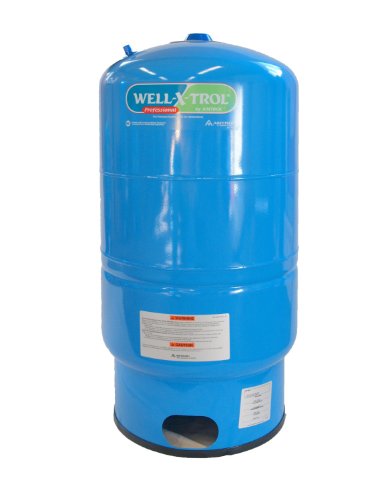
Amtrol Well-X-Trol WX-202 Well Pressure Tank, 20 Gallon
$327.99A virgin polypropylene liner and a positive hoop ring seal on the diaphragm, built for a long service life without maintenance.
Best for: Replacing a waterlogged pressure tank on a residential well where longevity matters most
Check price on AmazonWho should not buy this tier: Anyone whose well pump and pressure switch have not been sized together with the tank, because a mismatched drawdown or an incorrect switch setting causes rapid pump cycling regardless of which tank brand is installed. It is also not worth the premium for a household simply looking for the cheapest functional replacement of a still working tank.
How do I know if my pressure tank needs replacing rather than just recharging?
A tank that has lost its air charge, called waterlogged, cycles the pump on and off rapidly with very little water delivered between cycles, because there is no air cushion left to push water out smoothly. Recharging the air side to the correct pre-charge, generally about 2 PSI below the pump cut-in setting and checked with the tank fully drained of water, fixes a simple air loss. If the tank still cycles rapidly after a correct recharge, the diaphragm itself has likely failed and the tank needs replacing rather than recharging again.
How we chose these products
We compared manufacturer published capacity, drawdown and pressure switch specifications along with verified owner reviews, rather than installing these tanks ourselves. Where a manufacturer did not publish a drawdown figure for a specific model, we say so rather than estimating one.
How we chose
We did not test this equipment in person and we never claim to. Picks are researched from manufacturer specification sheets, published standards and regulatory limits, and the recurring themes in verified owner reviews. Every pick is matched to a real grain capacity, a real micron rating, a real certified claim or a real flow rating rather than to a price bracket, and it is placed in the tier where its published capability actually belongs. We rejected the unbranded flood that dominates several of these search results, because a softener is a pressure vessel on the main line and a filter is the only thing between a contaminant and a glass of water, and neither is a place for a product with no parts channel and no service path. Where a figure is trade convention rather than a published standard we label it that way, and where a manufacturer does not publish a figure we leave it out instead of estimating it. Above all, we do not recommend equipment for a problem nobody has measured.
Sources
- Manufacturer published specifications for the pressure tanks and switches linked on this page
Frequently asked questions
Why is a 20 gallon pressure tank not actually 20 gallons of usable water?
The nominal size describes the total tank volume, but the tank only delivers water between the pump cut-in and cut-out pressure settings, which is a fraction of that total. The published figure for one 20 gallon tank in this category is 7.2 gallons of usable drawdown at a 30/50 PSI switch setting, which is well under half the nominal size and is typical of the category.
Should treatment equipment be installed before or after the pressure tank?
After it, in almost every residential case. The pressure tank smooths out the pressure swings that come from the pump cycling on and off, and backwashing filters, softeners and ultraviolet systems all need that steady pressure and flow to work correctly. Installing treatment equipment ahead of the tank exposes it directly to pump cycling, which is harder on control valves and lamp performance alike.
How do I set the air pre-charge on a new pressure tank?
The tank must be completely empty of water when you check it, and the pre-charge is typically set to about 2 PSI below the pump cut-in pressure setting, using a standard tire gauge and a bicycle pump at the tank Schrader valve. Setting it with water still in the tank gives a false reading, and an incorrect pre-charge is one of the most common reasons a system delivers a trickle instead of steady pressure.
What causes a well pump to short cycle?
Short cycling, where the pump turns on and off rapidly, is almost always either a lost air charge in the pressure tank, called waterlogging, or a pressure switch set incorrectly for the tank installed. A failed diaphragm inside the tank produces the same symptom and cannot be fixed by recharging air, since the water side and the air side are no longer properly separated.
Does a bigger pressure tank mean fewer pump cycles?
Generally yes, because a larger tank holds more usable drawdown between cut-in and cut-out, which means the pump runs less often for the same household demand. Fewer cycles reduces wear on the pump motor and the pressure switch over time, which is why sizing a replacement tank to household peak demand, not just matching the tank that failed, is worth doing once rather than repeating a mismatch.
Do I need a low pressure cutoff switch on my well?
A low pressure cutoff switch shuts the pump down automatically if the well runs low or dry, rather than letting the pump run against no water and burn out the motor. It is inexpensive relative to a pump replacement and is worth adding to any well with a history of running low seasonally, or any well where the static water level has not been confirmed recently.
Get the complete water treatment shopping list
Every item in the starter, complete and premium systems for both city water and well water, with running totals, in one printable list. It opens with the test kit, because that is genuinely the first purchase. No charge.
One list, no sequence of daily emails, and you can leave at any time.
Researched, not professional advice. This page is compiled from published standards, regulatory limits, manufacturer specifications and owner-review consensus, not hands-on testing. Nothing here diagnoses a water problem or says any product makes water safe to drink. Figures described as a rule of thumb are water treatment trade convention rather than published standards, and they are labeled that way wherever they appear. Test your water before you buy equipment: on city water start with the Consumer Confidence Report your utility publishes each year, and on a private well only a certified laboratory test tells you what you have. Bacteria, nitrate, lead, arsenic and PFAS are not do it yourself topics, they are invisible and tasteless, and they need a laboratory and usually a licensed professional rather than a product. Remember that a certification covers a specific claim under a specific standard, so "NSF certified" with no number attached tells you very little.